Defining the Future of Supplier Management
From platform replacement to supplier experience strategy
Product Design Lead
Kroger Technology & Digital
Supplier Hub continues to meet core functional needs for downstream systems and sourcing data, but research revealed opportunities to improve the experience, reduce manual processes, and ensure data remains fresh throughout the supplier lifecycle.
As design lead, I helped define the vision for a next-generation supplier master data solution— exploring how to replace aging infrastructure, address fragmented processes, and better support sourcing, compliance, and supplier management while preserving critical operational integrations.
The current supplier management platform had become increasingly difficult to maintain due to legacy infrastructure, extensive customization, and limited scalability.
While it supported supplier profile data, compliance workflows, and onboarding across multiple internal teams, the platform no longer aligned cleanly with current business and user needs.
The organization was beginning to explore alternative SaaS solutions—but before evaluating vendors, the team needed to establish a clear baseline of what the business and its users actually needed.
Extensive customization created challenges around scalability and long-term flexibility.
Different teams had different requirements for supplier profile management.
The organization didn't yet have a clear picture of which supplier data was essential, optional, unnecessary, or missing.
The team needed evidence-based requirements and evaluation criteria to understand what a future platform would need to deliver.
I served as the design lead for discovery, responsible for understanding the current experience, defining user and business requirements, and creating a research-backed foundation for evaluating future solutions.
My focus was not to design the replacement. It was to help the organization understand what the replacement needed to be.
To understand the needs of both internal teams and external suppliers, I led a mixed-method discovery effort combining qualitative research, quantitative surveys, and data requirement analysis.
40
External Supplier Participants
30+
Internal Business Users
6
Business Functions Represented
Sourcing · Finance · Operations · Marketing · Compliance · Supplier Management
Research Activities
Stakeholder Interviews • User Interviews
Internal Surveys • External Surveys
Jobs-to-be-Done Analysis
Data Requirement Analysis • Opportunity Mapping
We started with a data problem.
Early assumptions suggested that the future solution needed to address gaps in the supplier data being collected.
Research revealed a bigger problem.

The biggest problem wasn't the data itself.
It was keeping supplier information
accurate, current, and accessible
through the workflows where people needed it.

Supplier information needed to capture the changes throughout the supplier relationship, not captured once during onboarding.
Internal and external users encountered disconnected tools, duplicate data entry, unclear ownership, and manual workarounds.
The value of supplier data depended on whether users could find and act on the right information at the right point in their workflow.
Supplier management wasn't a one-time setup task. It was an ongoing relationship.
Supplier information continued to evolve throughout the relationship, creating a need for ongoing maintenance, visibility, and support.
There was one shared underlying job across users:
Maintain a healthy supplier relationship with reliable information available when needed.

One of the most valuable outcomes of discovery was distinguishing between information that should remain relatively stable and information that changes as part of day-to-day operations.

Where could we make the biggest difference?
We translated the research into five areas where the future experience could create the most value for suppliers and internal teams.
Profile Management
Keep supplier information accurate and up to date throughout the supplier lifecycle.
Relationship management
Make it easier to manage the ongoing relationship between suppliers and internal teams.
Risk & compliance
Help teams understand supplier requirements, risks, and compliance obligations.
Support experience
Give suppliers clearer ways to find answers, guidance, and help when they need it.
Reporting & analytics
Make supplier information easier to monitor, understand, and act on.
Discovery changed the question.
From
which features should we build?
to
which capabilities and experiences are necessary to support the supplier lifecycle?
This reframing set the stage for the next phase: turning a complex ecosystem into a shared model of the future solution.
Discovery gave us a clearer picture of the supplier ecosystem—but it also surfaced a deeper problem.
Stakeholders could describe their workflows and needs, but they didn't yet share an understanding of what the future system should actually manage, where its boundaries should sit, or how the pieces of the ecosystem related to one another.
Before we could define requirements, we needed to define the system itself.
These weren't interface questions. They were domain-model questions.
We already had user research, Jobs-to-be-Done, use cases, process maps, and data requirements. Another list of features wasn't going to resolve the ambiguity.
Instead, I introduced an Object-Oriented UX (OOUX) approach to reframe the conversation around the underlying business model: What are we managing? How are those things related? Who owns them? And where do they belong?
I synthesized our research into a set of concrete business objects and relationships, then used that model to facilitate working sessions with business and technical stakeholders.
Challenged
Surfaced assumptions and asked whether something was actually an object, an attribute, or even part of the future system.
Prioritized
Distinguished critical, must-have, nice-to-have, and out-of-scope capabilities.
Aligned
Created a shared model that connected business needs with technical thinking.


The model gave stakeholders a shared framework for reasoning about the future product—turning abstract requirements conversations into concrete decisions about what the system should manage and where its boundaries should sit.
Before
"Should contact management be part of profile management?"
"Is industry an object or an attribute?"
"Does facility compliance belong here?"
"Who owns this data?"
After
Core
Supplier master data · Profile management · Identity & organization records · Critical compliance data
Adjacent
Relationship management · Contact management · Support experiences
Potentially outside the boundary
Operational purchasing processes · Certain downstream workflows · Data maintained elsewhere

Following discovery research and domain modeling, the team reached a critical decision point. Leadership needed to determine whether to continue investing in the existing supplier management ecosystem, modernize portions of it, or pursue a new platform altogether.
With upcoming budget planning requiring a clearer understanding of the market, potential solution approaches, implementation risks, and investment required, the team initiated a structured RFI process.
We knew
Where users struggled
Where processes were fragmented
Where data ownership was unclear
What the supplier lifecycle required
We didn't know
Could commercial platforms address those needs?
Which capabilities were truly foundational?
What implementation risks would we inherit?
How did vendors model the supplier lifecycle?
Which strategic path represented the best investment?
I worked with product, technology, and sourcing partners to translate discovery findings into a structured approach for evaluating potential solutions.
Rather than evaluating vendors against a disconnected list of feature requests, we developed questions grounded in the problems and requirements uncovered during discovery. This allowed the team to assess how different solutions approached the underlying needs, where they aligned with the future-state vision, and where significant gaps or implementation considerations remained.

We evaluated the model—not just the features.
I helped facilitate the conversations that allowed stakeholders to compare these options against user needs, data governance, technical complexity, organizational readiness, cost, and long-term strategic value.

From feature requests → business capabilities
The RFI gave stakeholders a shared vocabulary for evaluating what actually mattered.
From vendor comparison → strategic evaluation
The team could assess not only whether vendors offered functionality, but how their approaches aligned with the organization's data model, lifecycle, governance, and experience needs.
From replacement mindset → ecosystem strategy
The evaluation process moved the conversation beyond simply replacing Supplier Hub. Stakeholders began considering a broader future-state supplier experience centered on unified supplier interactions, lifecycle management, centralized governance, visibility, and integration across the ecosystem.
We started by asking which system to replace. We ended by asking what experience we wanted to create.
The original goal of the initiative was to evaluate options for replacing a legacy supplier management platform. Through the research process, we developed a broader understanding of the underlying problem: the platform itself wasn't the primary issue. The larger challenge was a fragmented supplier experience spanning multiple systems, teams, and processes. Research consistently showed that both suppliers and internal teams struggled with disconnected workflows, unclear ownership, duplicated effort, and limited visibility across the supplier lifecycle. As a result, stakeholders recognized that replacing a single system would address only part of the problem.
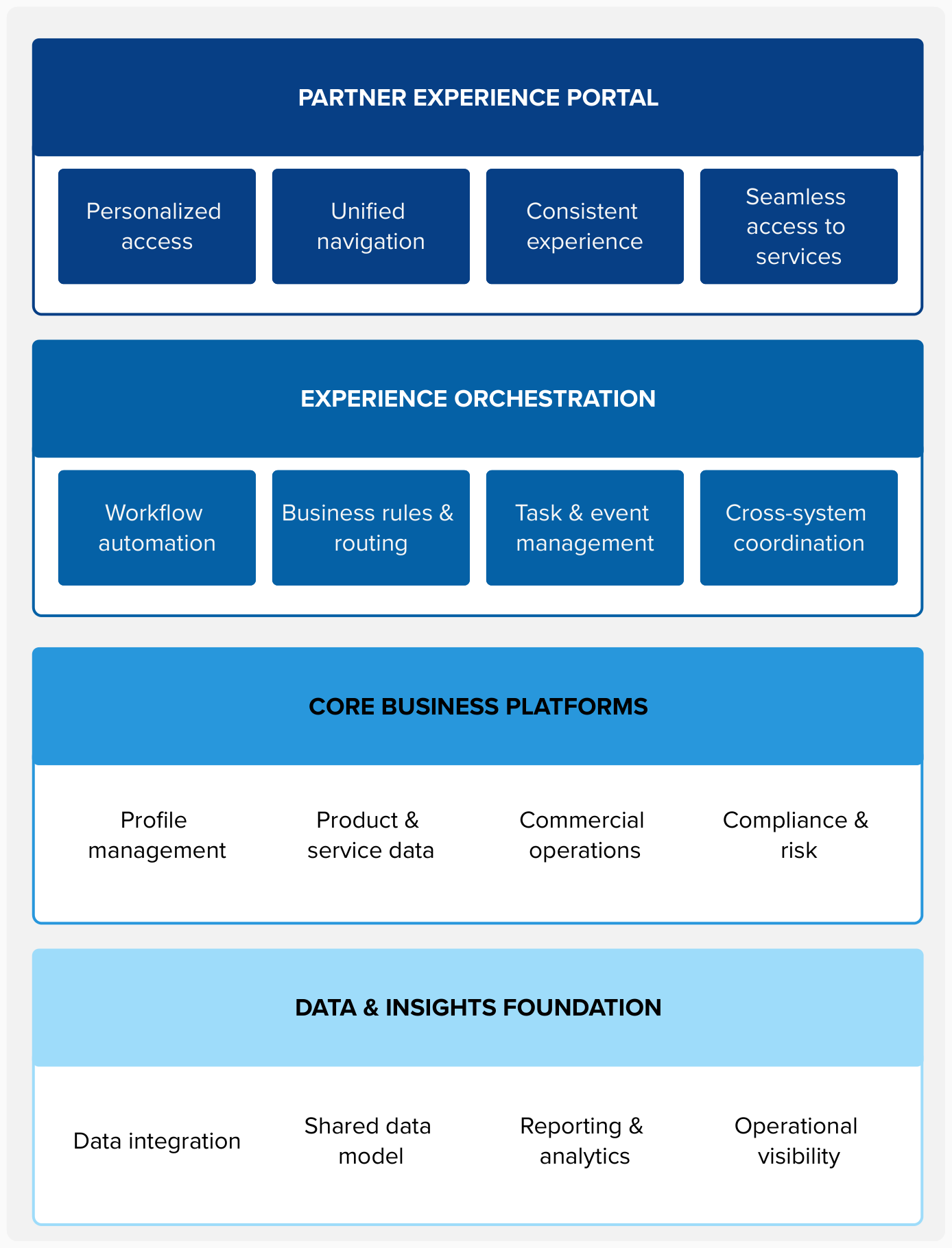
To support funding discussions and future planning, I translated research findings, OOUX outputs, and vendor learnings into a future-state experience strategy. Working closely with product leadership, I shaped the vision, storytelling, and artifacts used to communicate the business case for a more unified supplier experience.
Visibility · Support · Lifecycle management · Long-term modernization
From
Which system should we replace?
to
What experience are we trying to create?
The proposed strategy shifted the focus from replacing individual systems to creating a more cohesive supplier experience across the ecosystem—allowing modernization to happen incrementally rather than requiring every underlying system to be replaced at once.
Synthesized discovery research, user feedback, and vendor evaluation findings into long-term supplier experience vision and roadmap.
Facilitated stakeholder alignment around multiple future-state investment options.
Collaborated on materials used to communicate the business case and support organizational funding.
Advocated for an experience-led approach focused on end-to-end supplier journeys rather than individual system replacements.
This project expanded my understanding of what product design can contribute in complex enterprise environments. I entered the initiative focused on replacing a legacy platform; I left having helped shape a broader product strategy spanning research, domain modeling, vendor evaluation, stakeholder alignment, and investment planning. The biggest lesson was that the most valuable design outcome isn't always a new interface.
Sometimes it's helping an organization see the problem differently—and giving people a shared framework for deciding what to do next.
